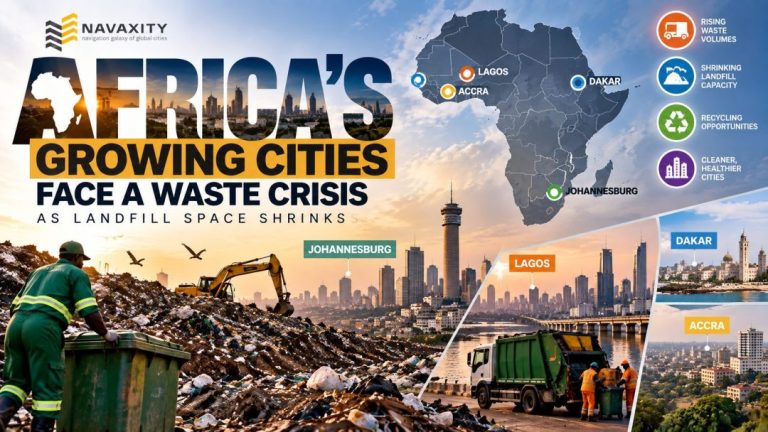




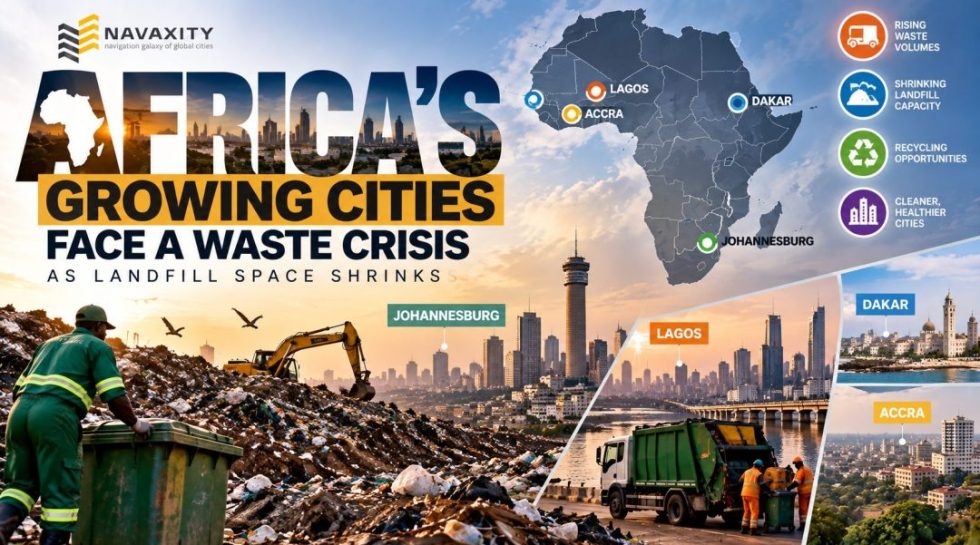
Rapid urban growth is putting waste-management systems under increasing pressure across some of Africa’s largest cities, with Johannesburg, Lagos, Dakar and Accra confronting rising waste volumes, limited disposal capacity and inadequate collection infrastructure.
The problem is particularly visible in Johannesburg, where illegal dumping has expanded rapidly as municipal landfill capacity declines. A recent report by The Associated Press found more than 2,000 illegal dumping hotspots identified across the city, while some residents reported waiting weeks for household waste to be collected.
The situation highlights a wider urban challenge across the continent: population growth is increasing the amount of waste cities must collect and process, while investment in collection, recycling and disposal infrastructure has struggled to keep pace.
Johannesburg’s Landfill Capacity Is Running Out
Johannesburg provides one of the clearest examples of the problem. A municipal landfill in the city reached capacity and closed in 2010, contributing to the growth of informal dumping areas such as the large site in Kya Sands, an industrial area in the northwest of Johannesburg.
According to the AP report, only two of Johannesburg’s four municipal landfills currently accept general waste, while a recent study by South Africa’s Council for Scientific and Industrial Research (CSIR) found that the city’s remaining landfill capacity could be less than one year on average.
The city’s waste-management company, Pikitup, has identified more than 2,000 illegal dumping hotspots and allocated approximately 115 million rand ($6.4 million) during the 2025/26 financial year to address the problem.
Johannesburg’s municipal government has also launched targeted clean-up campaigns. In August, the City of Johannesburg worked with Pikitup, Johannesburg Water, the Johannesburg Roads Agency, municipal police and community organisations to clear illegal dumping sites in areas including Alexandra and along major transport corridors.
City of Johannesburg: Illegal dumping clean-up programme
Why Rapid Urbanisation Is Making the Problem Harder
Africa’s urban population is expected to continue expanding rapidly.
The AP reports that Africa’s urban population is projected to double to around 1.4 billion people by 2050. At the same time, the World Bank estimates that waste generation in sub-Saharan Africa could increase by 124% between now and 2050, the fastest projected growth among the world’s regions.
The challenge is therefore not simply that cities currently have too much waste. Municipalities must also build systems capable of handling substantially larger volumes in the future.
That requires investment across the entire waste chain:
- household and commercial collection;
- transfer stations;
- recycling and material recovery;
- organic waste treatment;
- landfill capacity;
- waste-to-energy facilities;
- and formal support for informal waste workers.
Lagos Is Exploring Waste-to-Energy
Lagos illustrates another side of the challenge. Nigeria’s largest city is increasingly looking toward waste-to-energy and waste recovery as alternatives to conventional dumping. According to The Guardian Nigeria, Lagos is now estimated to generate approximately 17,000 tonnes of waste per day, up from the 13,000-tonne figure previously used by the state government.
The state’s waste-management authority, LAWMA, reported evacuating approximately 418,500 tonnes of waste during May 2026, equivalent to around 13,200 tonnes per day during that month. The difference between the reported generation and collection figures illustrates the scale of the logistical challenge, although the figures cover different periods and should not be interpreted as a precise measurement of an accumulated backlog.
Lagos is attempting to address the problem by developing transfer stations, material-recovery facilities and waste-to-energy initiatives while reducing reliance on ageing dumpsites.
The Environmental Cost of Poor Waste Management
The consequences extend well beyond unpleasant streets. Open dumping and burning can release pollutants into the air, soil and water, while discarded waste can obstruct drainage systems and increase the risk of flooding. In Johannesburg, researchers and environmental specialists cited by AP have warned that poorly managed waste contributes to pollution, attracts vermin and can block stormwater infrastructure.
Illegal dumping also creates a difficult cycle. When formal collection becomes unreliable, residents and businesses may turn to informal waste haulers. Where legal disposal fees and registration requirements make formal disposal expensive, some operators may resort to illegal dumping. The result is a system in which weak municipal collection can unintentionally create incentives for further informal disposal.
Recycling Could Reduce Pressure on Landfills
Johannesburg’s experience also points toward a potentially important solution: diverting waste before it reaches landfill. Researchers cited by AP estimate that as much as 80% of Johannesburg’s waste could potentially be diverted through recycling and treatment of organic waste if households and businesses separated materials at the source.
Waste pickers already play an important role in recovering recyclable materials, but the sector remains largely informal. Greater access to collection points, protective equipment, storage facilities and community recycling centres could allow informal recyclers to become a more integrated part of municipal waste systems.
A New Urban Infrastructure Challenge
The waste crisis is becoming increasingly important to the future planning of African cities. For rapidly growing metropolitan areas, waste management is now closely connected to land use, public health, transportation, environmental resilience and urban finance.
Landfills require large amounts of land and eventually reach capacity. Transporting waste over longer distances increases operational costs. Recycling and composting require separate collection systems. Waste-to-energy facilities require significant investment and reliable waste streams.
Meanwhile, the amount of waste generated by growing populations continues to increase.