





A Perspective by Yavuz Duvarchi, Urban Planning, Izmir Institute of Technology
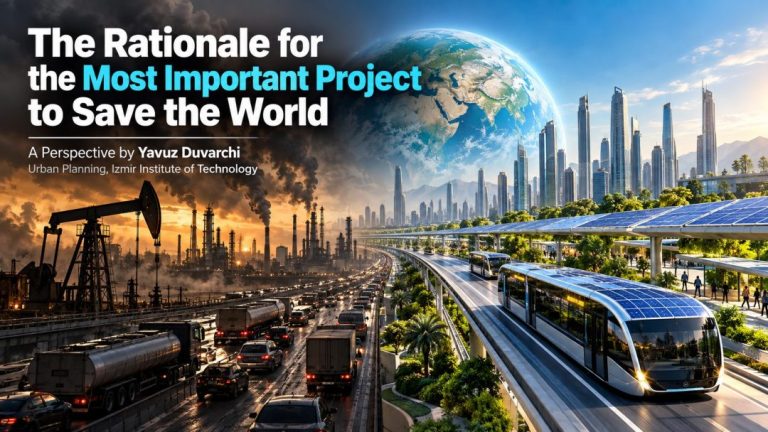
The connections between fossil fuels, transportation, environmental destruction, and global peace raise fundamental questions about humanity’s future. Solar-powered transportation could serve as a practical starting point for addressing some of the world’s most pressing challenges, linking local action to a broader vision for a sustainable world.
Why Small, Piecemeal Projects Are Not Enough
Small, “piecemeal” projects, based on the idea of advancing inch by inch, will not save the world. On the contrary, they are distractions and illusions, and frankly, manipulative ploys and diversions of capitalism designed to ensure that it continues along its established path. As is well known, capitalism is a “vampire” created by human hands that is extinguishing the world’s future. It is a form of “evil” designed solely to enrich and entertain a small, happy minority.
Should we start from a grand vision or philosophy that stands against capitalism? Is this an absolute necessity? Can a movement against capitalism emerge from within the capitalist system itself? These are broad questions that require in-depth consideration.
Since the world’s level of consciousness has not yet reached this level of understanding, we must once again start from the grassroots and the practical level, from engineering and practice, but through large-scale practical projects.
It is absolutely essential to begin with grand ideas, those offering high added value to humanity and nature, supported by substantial funding and demonstrated through concrete local implementations. These projects must be firmly proven, and society must be shown the actual feasibility of global liberation through local examples. Such local implementations do not mean proceeding “inch by inch” with small, low-value-added and insignificant projects that “do not make a dent.” This is a kind of “Think Globally, Act Locally” approach.
Which key concrete initiative, if we were to start with it, could lead us toward a general, comprehensive and ultimately global solution? The sole reason the world has been unable to emancipate itself from its problems may be that, instead of funding grand ideas and projects, we continue to fund the distracting, “onion-skin” projects mentioned above. This is not merely a massive waste of resources; it is also a grave act of betrayal. In the truest sense of the word, it is the reckless squandering of societal resources on trivial, low-value-added projects. This pattern is particularly widespread in developing countries like ours, preventing big ideas and high-value-added projects from coming to the forefront.
The real problem lies in determining where to begin at the local level and in practice, and where to find that starting point. While it may be necessary to start from the bottom up, from the local level, we must also approach the issue from a holistic perspective to identify the appropriate starting point.
Nature and Humanity: The Fundamental Principle
If the idea of liberating nature and humanity from their problems is taken as the fundamental starting point, then nature and humanity are the essence, and every goal must be directed toward them. Although saving the Earth and humanity can be considered two fundamental goals, they should be understood as interconnected and inseparable ideas and objectives.
Human nature is often in conflict with that of nature. Nature is the source, and humans constantly take from it, often without replacing what they take. The outcomes of human development are frequently disruptive to nature’s integrity and structure, especially when development proceeds at a pace and scale that nature cannot absorb.
Therefore, humanity and the human subject must be in harmony with nature, or, in Spinozist terms, “adequate” to it, so that nature and humanity can be considered a single idea. The reverse is hardly possible: one cannot say that nature must fit humanity. The relationship is therefore one-sided. Humanity must be in harmony with nature, the Earth, and all other assumptions must follow accordingly.
No matter how one looks at it, the primary or foundational idea that must be considered is Nature, and consequently the issue of harmony with nature. If we protect nature, we automatically protect human beings. All human activities and technologies must therefore be congruent with nature, without exception. Of course, in this formulation, humanity and its needs are not elements to be sacrificed, ignored, abandoned or pushed aside.
If nature is the dominant matter to protect and follow, we must ask where the greatest threat to nature comes from. Since the threat to nature cannot come from nature itself, the threat, paradoxically, comes from human activities. This paradox stems from humanity’s “false consciousness” and its choices in relation to nature. The threat is directed not only at nature but also at humanity itself, since humanity is always dependent on nature and bound by the condition of harmony with it. When humanity harms nature, it automatically harms itself as well, in the medium and long term.
Fossil Fuels, Oil and the Threat to World Peace
When we examine human activities and the phenomena that run counter to nature and could pose a threat, the threat stems primarily from the most widely adopted form of energy: the use of the wrong type of energy.
Today, the form of energy that poses the greatest threat to nature is fossil fuels, specifically petroleum products. These are non-renewable and cause major environmental problems. This trajectory of development contains numerous violations of nature and, consequently, of humanity itself. Today, industries are deeply dependent on petroleum products.
However, the “efficiency” of oil as an energy source is precisely what lures humanity. Because of this perceived efficiency, humankind has become dangerously dependent on this energy source. As a result of this heavy dependence, world peace is now under great threat.
Oil has merged with capitalism, which itself represents a threat to world peace. Furthermore, the management and control of oil resources create geopolitical issues that threaten world peace and lead to an arms race. This gives rise to and further strengthens the military-industrial complex, which profits from these conditions. This, in turn, poses another threat to world peace and, moreover, to nature itself.
At this point, the world’s primary problem is world peace. This situation has become directly linked to the control of oil. Solving the oil problem will resolve this central issue facing the world, or the reverse.
Transportation as the Critical Point of Departure
“Efficient” oil has become an indispensable cornerstone of the transportation sector, arguably the most critical and important sector. The pursuit of efficiency in transportation further entrenches the threat.
Ultimately, through transportation, the capitalist economic system is reinforced. Transportation is the most fundamental common denominator of all economic sectors, and the “false consciousness” stemming from dependence on oil as the primary energy source in current transportation has also been reinforced.
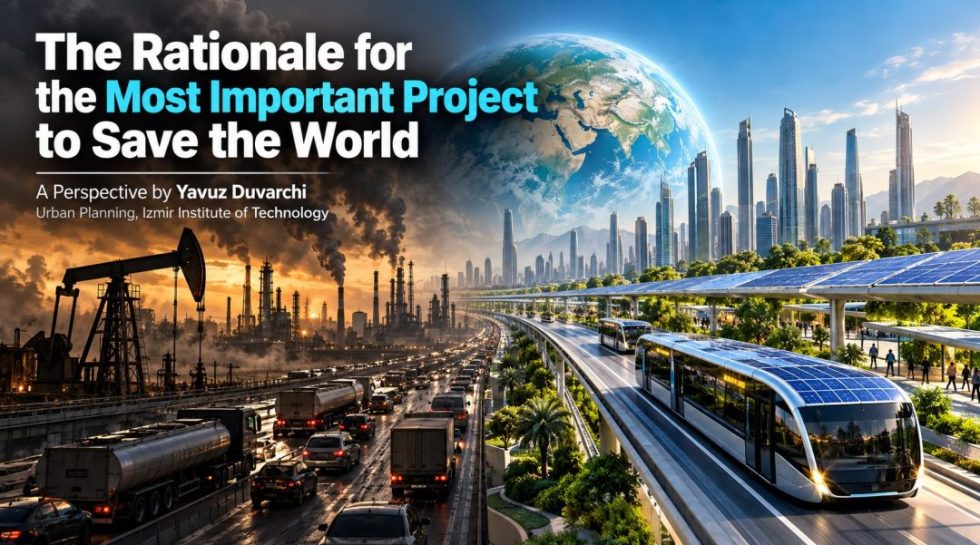
Accordingly, developing an alternative energy system or model that utilizes alternative energy sources in transportation, and demonstrating through local examples that such a system can serve as a starting point for supporting both nature and humanity, will reveal the most important point of departure.
Solar-Powered Transportation: From Universal Principles to Concrete Action
For all these reasons, the most effective way to save the world, including nature, humanity and the Geist, would be to develop a transportation model based on solar energy, the most renewable energy source, and capable of utilizing it in the most “efficient” manner. In the author’s view, this would be the most suitable and vitally important project for humanity and nature, as it represents the most natural approach.
In this way, all of the world’s major problems, including the constant risk of war and perhaps the resulting nuclear annihilation, as well as the destruction of nature and consequently humanity, would come to an end and gradually fade away. This would occur through freeing ourselves from “false consciousness” and corporate capitalism. Through its consumerism, capitalism has long posed a threat to nature and, consequently, to humanity.
In this way, the correct and most important project to undertake, and how it should be carried out, can be demonstrated by moving from universal principles down to the particular, or the concrete.