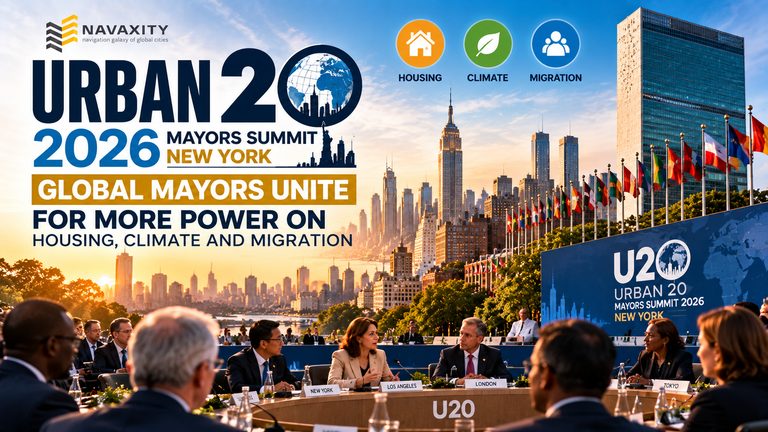






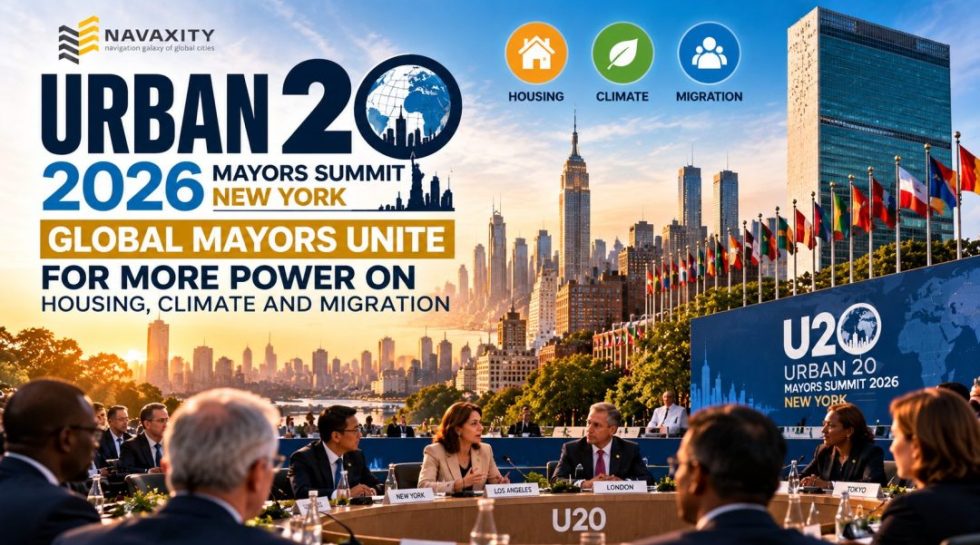
Mayors and senior city officials from around the world have called for greater authority, financing and policy tools for cities to address some of the most pressing urban challenges, including housing affordability, climate resilience and migration.
The call came at the 2026 Urban 20 (U20) Mayors Summit, held in New York from September 19 to 21 and co-hosted by New York City and Los Angeles. The summit brought together representatives from 34 cities across G20 countries, according to the New York City Mayor’s Office.
The meeting comes as cities face increasingly interconnected pressures. Housing shortages are pushing up costs, extreme heat and flooding are creating new infrastructure demands, and migration is changing the demographic profile of metropolitan areas.
Cities Want More Control Over Housing Policy
Housing affordability was one of the central issues discussed at the summit.
The U20 communiqué calls for national governments to give cities greater authority over their local housing markets. Proposed areas of greater municipal control include tenant protections, rent stabilization and rent control, limits on short-term rentals and inclusionary zoning.
Mayors also called for more predictable public funding and greater direct access to housing finance through multilateral development banks. The underlying argument is that national governments control many of the financial and regulatory mechanisms that affect housing, while cities are responsible for dealing with the consequences at street level.
That mismatch has become increasingly visible in major metropolitan areas where housing demand is rising faster than new supply.
Climate Resilience Moves Closer to the Center of Urban Planning
Climate change was another major focus of the New York summit.
City leaders highlighted the need to protect residents from extreme heat, flooding and other climate hazards, while also reducing urban emissions.
The U20 communiqué calls for cities to have greater access to international climate finance and a more formal role in national climate and energy planning. It also emphasizes the importance of meteorological and public-health data for operating early-warning systems.
For cities, this represents a shift from treating climate policy primarily as an emissions issue toward a broader focus on urban resilience.
Heat-resistant streets, flood protection, energy-efficient buildings, public transport and urban greenery increasingly form part of the same planning conversation.
Housing and Climate Are Becoming One Urban Policy Problem
The summit also reflected a growing recognition that housing and climate policy cannot easily be separated.
Cities need to build more homes, but those homes also need to be located in places that are accessible to public transport and resilient to climate risks.
A report released during New York Climate Week by Ramboll and C40 Cities identifies ten approaches that cities are already using to address housing and climate objectives together. These include combining affordable housing development with low-carbon construction, better transport connections and climate-resilient infrastructure.
The concept is increasingly relevant to rapidly growing cities where expanding the housing stock without considering transport, energy and climate resilience can simply create a new set of infrastructure problems.
Migration Is Also Becoming a City-Level Issue
Migration was the third major theme of the U20 discussions.
Cities often provide the housing, transportation, healthcare, education and employment services that migrants depend on, even when migration policy itself is largely determined at national level.
The summit therefore included migration alongside housing and climate as interconnected urban challenges. C40 said city leaders were seeking practical approaches that make communities safer, healthier and more resilient for both newcomers and long-term residents.
This is particularly important for large metropolitan areas where population growth can increase demand for housing and public services regardless of whether the new residents arrive through international migration or domestic mobility.
Why the U20 Matters for Global Cities
The Urban 20 brings together cities from G20 countries to ensure that urban priorities are represented in discussions involving national governments.
According to Smart Cities World, the participating cities represented more than 500 million people and roughly one-third of global GDP.
That gives city governments a significant collective economic and demographic weight, even though many of the financial and regulatory decisions affecting urban development remain at national level.
The 2026 summit therefore focused not only on what cities are doing themselves, but also on what they need from national governments and international financial institutions.
New York Becomes a Meeting Point for the Urban Agenda
The timing of the summit was significant.
The U20 meeting took place during Climate Week NYC, bringing city leaders together with discussions about climate finance, housing, sustainable data centres, clean air and urban resilience.
New York has also become a focal point for discussions about how major cities should respond to rapidly changing economic and environmental conditions.
The city’s role as co-host, alongside Los Angeles, gave the 2026 summit a strong North American presence while maintaining its global scope.
The Next Challenge Is Implementation
The communiqué represents a collective position from participating city governments, but implementation ultimately depends on national governments, legislatures, financial institutions and local authorities.
The issues identified by the mayors also vary considerably between cities.
A housing strategy that works in a dense European capital may not translate directly to a rapidly expanding African or Asian metropolitan area. Similarly, climate risks differ between coastal cities, inland cities and regions exposed primarily to extreme heat.
The common factor is the growing need to coordinate housing, transport, infrastructure, climate adaptation and economic development rather than treating them as separate urban policies.
References:
New York City Mayor’s Office: 2026 Urban 20 Mayors Summit
C40 Cities: Global city leaders at the 2026 U20 Summit
Smart Cities World: Mayors set out joint action on housing, climate and migration