





October 13, 2026 | Analysis | United States
America’s geography of work is changing. The 2026 Best Cities for Work ranking from Indeed Hiring Lab shows that the strongest worker-oriented labor markets are not concentrated exclusively in the country’s largest coastal metropolitan areas. Among the 25 highest-ranked metropolitan areas, nine are located in the Midwest, while Boston, Washington, D.C., and Burlington occupy the top three positions.
The ranking evaluates 228 U.S. metropolitan areas across 40 metrics covering job opportunity, compensation, job quality and security, career mobility, work-life flexibility and economic opportunity. The results offer a useful lens through which to examine how America’s urban labor market is evolving.
The 2026 Best Cities for Work ranking offers a useful snapshot of how different parts of the United States are performing from the perspective of workers.
According to Indeed Hiring Lab, the index evaluates 228 metropolitan areas using 40 metrics across six dimensions. Boston ranks first, Washington, D.C. second and Burlington, Vermont third, while San Jose, San Francisco, Madison and Rochester also appear near the top. Indeed Hiring Lab
But the more interesting story begins when the 25 metropolitan areas are mapped geographically. The distribution suggests that America’s strongest worker-oriented labor markets are not concentrated exclusively in its largest cities or most populous states.
1. The East Coast Remains Strong at the Top
The first striking pattern is the continued strength of the Northeastern and East Coast labor markets.
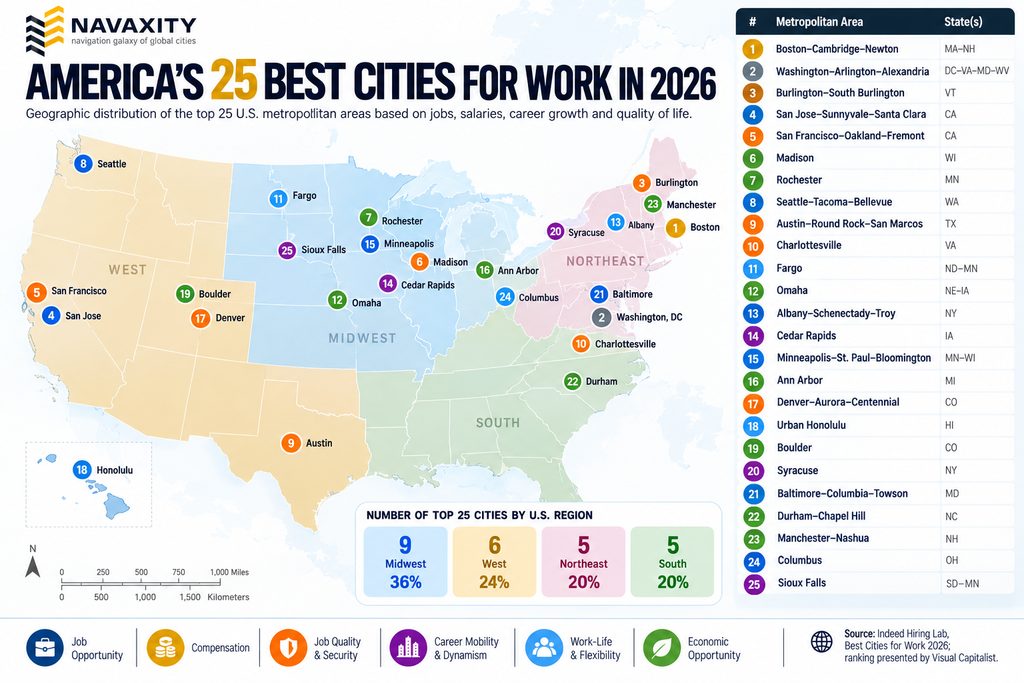
Boston occupies the top position, followed by Washington, D.C., while Burlington is third. Further down the list, the Northeast is represented by Albany, Syracuse and Manchester. If the five Northeastern metros in the top 25 are counted together, the region accounts for 20% of the list.
Washington, D.C. requires a slightly different treatment. The Census Bureau classifies Washington, D.C. within the South, even though geographically and economically it is often discussed as part of the broader East Coast. For an analysis of America’s economic geography, it is therefore more useful to distinguish between geographical East Coast presence and formal Census regional classification.
Boston’s position is particularly interesting because it is not based on one exceptional metric. It ranks second in career mobility, fifth in economic opportunity and sixth in compensation, producing a strong overall balance. Washington follows a different pattern, ranking first in career mobility and third in compensation.
This suggests that the northeastern advantage is not simply a matter of having more jobs. It is also connected to dense networks of employers, universities, professional services, healthcare, technology and knowledge-intensive industries.
New York Is the Big Exception
Perhaps the most interesting absence is New York City.
New York is not a weak labor market. Indeed places it among the top five metropolitan areas for Career Mobility & Dynamism. Yet it does not make the overall top 25 because of weaker results in Job Opportunity and Economic Opportunity.
A city can have an enormous number of employers and career opportunities while still producing less favorable outcomes across other dimensions measured by the index. In other words, economic scale does not automatically translate into a top position in a worker-centered ranking.
Chicago’s absence reinforces the same point. The ranking should not be interpreted as a league table of America’s economically most important cities.
The full ranking and underlying statistics are available in Navaxity’s [25 Best U.S. Cities for Work in 2026]
2. The Midwest Has Become a Major Presence
The strongest geographical surprise is arguably the Midwest. Using the U.S. Census regional classification, nine of the 25 metropolitan areas are in the Midwest:
Madison, Rochester, Fargo, Omaha, Cedar Rapids, Minneapolis–St. Paul, Ann Arbor, Columbus and Sioux Falls.
That is 9 out of 25, or 36% of the entire ranking. This is a substantial representation considering that many of these metropolitan areas are far smaller than the country’s largest coastal cities.
Madison ranks second nationally for Job Opportunity, while Rochester ranks first for Economic Opportunity. Ann Arbor ranks second for Job Quality & Security and third for Career Mobility. Sioux Falls ranks third for Job Opportunity.
The pattern suggests that some Midwestern cities are benefiting from a combination of tight labor markets, diversified regional economies, specialized industries, education systems and comparatively strong worker outcomes.
This is different from the traditional image of the Midwest as an area whose economic importance is primarily tied to declining industrial employment.
The 2026 data show a more complicated regional economy, combining manufacturing with healthcare, education, technology, logistics, professional services and other sectors.
3. The West Is Powerful, but Its Strength Is More Concentrated
The western United States contributes several major metropolitan areas to the top 25, including San Jose, San Francisco, Seattle, Austin, Denver, Boulder and Honolulu. San Jose ranks first nationally for compensation, Seattle second, San Francisco fourth and Austin fifth.
This is particularly important because the Indeed methodology adjusts wage measures for taxes and regional price differences rather than simply comparing nominal salaries.
At the same time, several western cities show weaker results in other dimensions. San Jose, for example, ranks first for compensation but only 24th for Economic Opportunity. Seattle ranks second for compensation but 21st for Economic Opportunity. Austin ranks fifth for compensation but 25th for Economic Opportunity.
Consequently, it would be misleading to explain the western region’s distribution simply through a claim that California or Nevada is “too consumerist” or contributes less to U.S. GDP. The dataset does not measure consumerism as a causal factor, and California is one of the country’s largest economic centers.
4. Seattle Shows Why a City Can Be Both High-Paying and Industrial
Seattle is particularly useful as a case study because it complicates the idea that the modern western economy is simply a technology economy. The Seattle metropolitan economy is associated with major companies including Amazon, Microsoft and Boeing, while the region also maintains substantial aerospace, manufacturing, maritime and logistics activity.
The city itself identifies the Greater Duwamish Manufacturing and Industrial Center and the Ballard-Interbay Northend Manufacturing and Industrial Center as major industrial areas. Boeing’s presence is especially significant for the regional industrial economy, with major commercial-aircraft manufacturing operations in the Puget Sound region.
Seattle therefore represents a hybrid economic model: technology + aerospace + manufacturing + maritime activity + logistics + professional services.
That diversity is relevant because Indeed’s Job Quality & Security pillar explicitly considers industry diversification, alongside employment stability, benefits and exposure to potential AI-driven disruption. Seattle’s eighth-place overall ranking and second-place compensation ranking therefore reflect a labor market that is strong in several areas while still facing challenges in other worker-oriented dimensions.
5. The Real Divide May Not Be East vs. West
The geographic map becomes more interesting when we move beyond the traditional East Coast–West Coast narrative.
The top 25 can be roughly divided into four broad regional groups:
| U.S. Region | Top-25 Metros | Share |
|---|---|---|
| Midwest | 9 | 36% |
| West | 6 | 24% |
| Northeast | 5 | 20% |
| South | 5 | 20% |
Regional grouping follows the U.S. Census Bureau’s broad regional classification. Washington, D.C. is counted within the South under this framework. This produces a striking result: the Midwest has more metropolitan areas in the top 25 than any other Census region.
The finding does not mean that the Midwest has become America’s dominant economic region. It means something more specific: a relatively large number of Midwestern metropolitan areas score strongly when employment conditions are evaluated through the particular worker-centered framework used by Indeed.
6. Why Smaller Cities Are Appearing Near the Top
Perhaps the most important analytical finding is the performance of smaller metropolitan areas.
Burlington ranks third nationally, despite its much smaller population than Boston, San Francisco or Seattle.
Rochester ranks seventh and first nationally for Economic Opportunity. Madison ranks sixth and second for Job Opportunity. Fargo, Cedar Rapids and Sioux Falls also make the top 25.
These results indicate that urban scale is not the same thing as labor-market quality.
Smaller metropolitan areas can benefit from tighter labor markets because employers may face stronger competition for available workers. At the same time, specialized institutions can have an outsized economic impact.
Rochester is a useful example. Its economy is strongly influenced by the presence of the Mayo Clinic, helping create a specialized employment ecosystem in healthcare and related industries. Indeed identifies Rochester as the highest-ranked metro in the country for Economic Opportunity.