





The geography of Eurasian trade is changing. As governments and businesses seek alternatives to established transport routes, the Middle Corridor is attracting renewed attention as a multimodal link between Asia and Europe.
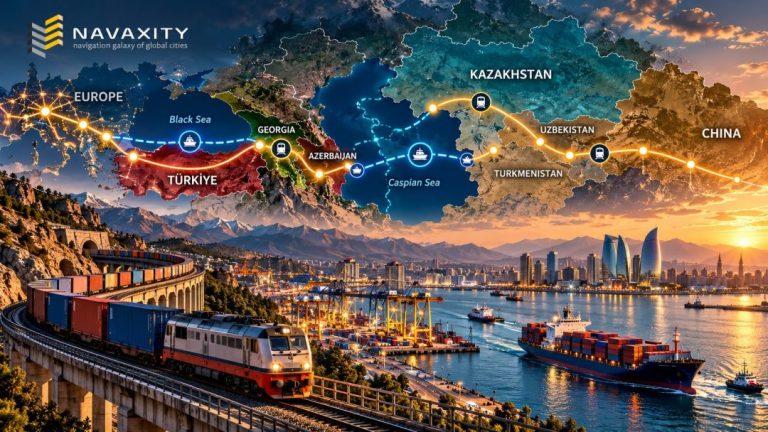
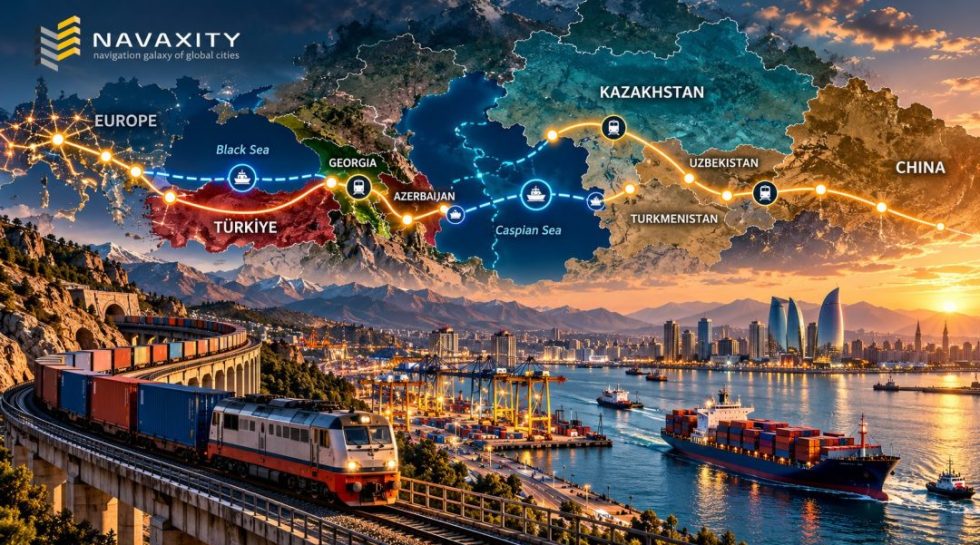
Also known as the Trans-Caspian Transport Corridor, the route connects Central Asia with the South Caucasus, Türkiye and European markets through a combination of railways, roads, Caspian Sea shipping and connections across the Black Sea. Its development could reshape regional logistics, but its long-term success depends on more than geography.
A Strategic Route Across the Caspian Sea
The corridor links countries including Kazakhstan, Azerbaijan, Georgia and Türkiye, while connecting Central Asian markets with wider international trade networks. For these countries, it is not simply a transit route between China and Europe. It can also support regional trade, improve access to export markets and strengthen economic links between neighboring economies.
The World Bank’s research on the Middle Corridor highlights the importance of upgrading railways, ports and intermodal facilities, particularly in Kazakhstan, Azerbaijan and Georgia.
The corridor has gained strategic attention as businesses and governments seek to diversify supply chains and reduce dependence on individual transport routes. However, greater interest does not automatically make the route faster, cheaper or more reliable than competing alternatives.
Investment Is Growing, but Bottlenecks Remain
On September 28, 2026, the World Bank announced a new report on the Trans-Caspian Transport Corridor. Its modelling suggests that strategic investment could more than triple trade volumes along the route and halve travel times by 2040. Combining infrastructure investment with reforms to improve transport efficiency could deliver even larger gains.
These are projections, not guaranteed outcomes. The report emphasizes better-connected railways, ports, logistics hubs and digital systems, alongside stronger coordination between countries and transport operators.
The European Union is also backing improved connectivity. In June 2026, the European Commission announced a Connectivity Agenda Platform and agreements with international financial institutions expected to mobilize up to €2 billion for strategic connectivity investments in the Black Sea region and the South Caucasus.
Sources: World Bank and European Commission.
Yet infrastructure is only part of the challenge. Border procedures, transfers between ships and trains, port capacity, fragmented documentation and coordination across multiple jurisdictions can all affect delivery times and costs. A corridor is only as reliable as its most difficult connection.
Digital Trade Could Help Close the Gap
Recent developments suggest that improving the corridor is not only about building tracks and expanding ports. Digital customs procedures can also reduce delays and simplify cross-border transport.
In August 2026, the United Nations Economic Commission for Europe reported that Azerbaijan, Turkmenistan, Uzbekistan and Tajikistan had completed pilot transport operations using the electronic TIR system. Several involved multimodal journeys crossing the Caspian Sea.
The trials demonstrate progress toward paperless transit procedures, although pilot operations alone do not establish that the entire corridor now operates seamlessly.
Source: UNECE.
What It Means for Eurasian Cities and Economies
The Middle Corridor could influence more than international freight flows. Ports, railway junctions, logistics centers and border cities may benefit from improved connectivity, while exporters could gain access to a wider range of markets.
For Kazakhstan, the route offers another way to connect its economy to international trade. Azerbaijan and Georgia occupy key positions between the Caspian Sea and the Black Sea, while Türkiye provides onward connections toward Europe. The distribution of benefits, however, will depend on investment decisions, transport costs, local economic capacity and coordination between participating countries.
The corridor also illustrates a broader change in economic geography: connectivity is becoming a strategic asset. Countries are not only competing to produce and sell goods. They are also seeking to shape the networks through which goods move.
A Corridor Still Under Construction
The Middle Corridor has considerable potential, but it should not be treated as a ready-made replacement for other Eurasian routes. Its competitiveness will depend on whether governments and operators can make transport predictable across rail, sea and road connections.
Investment announcements and optimistic forecasts matter, but the decisive measures will be practical: actual transit times, total shipping costs, freight volumes, border delays and the reliability of connections between countries.
The corridor’s future will therefore be determined not by geography alone, but by the ability to turn a chain of separate national transport systems into a coordinated international network.