





The Persian Gulf’s $100 Billion Gamble: Can These Megaprojects Survive the War?
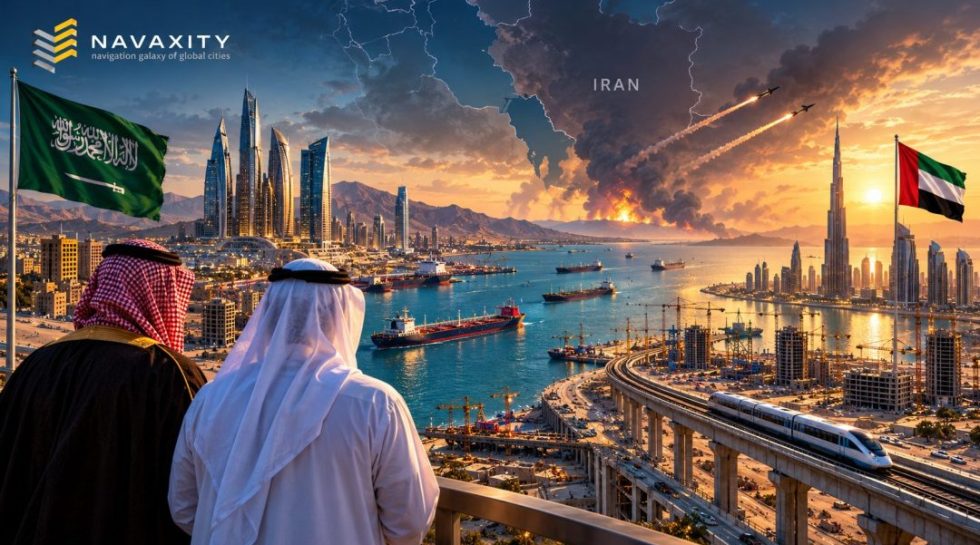
From Saudi Arabia’s NEOM to the planned Gulf railway, the Persian Gulf’s megaprojects reflect enormous economic ambitions. But regional conflict, investment uncertainty and vulnerable trade routes are testing the Gulf’s vision of becoming a global economic powerhouse.
The Persian Gulf has become a centre of ambitious urban development and infrastructure investment. Saudi Arabia, the United Arab Emirates (UAE) and other Gulf states are building projects intended to diversify their economies, attract international capital and strengthen their positions in global trade.
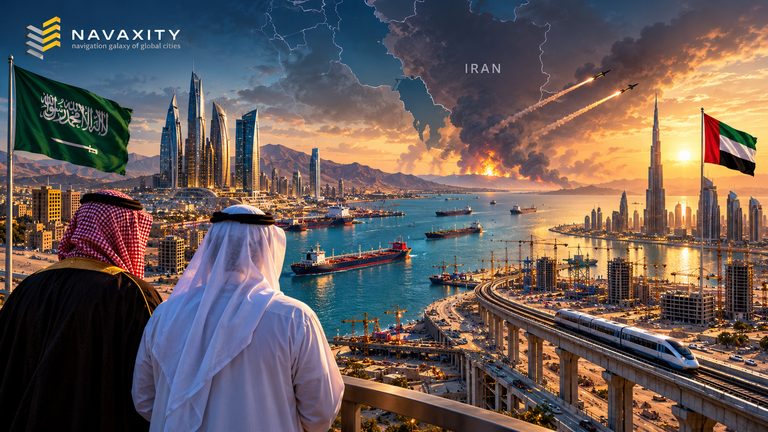
Yet the war involving Iran has raised questions about the risks surrounding these ambitions. Disrupted energy exports, threats to maritime routes and uncertainty among investors could affect not only individual projects but also the region’s wider economic transformation.
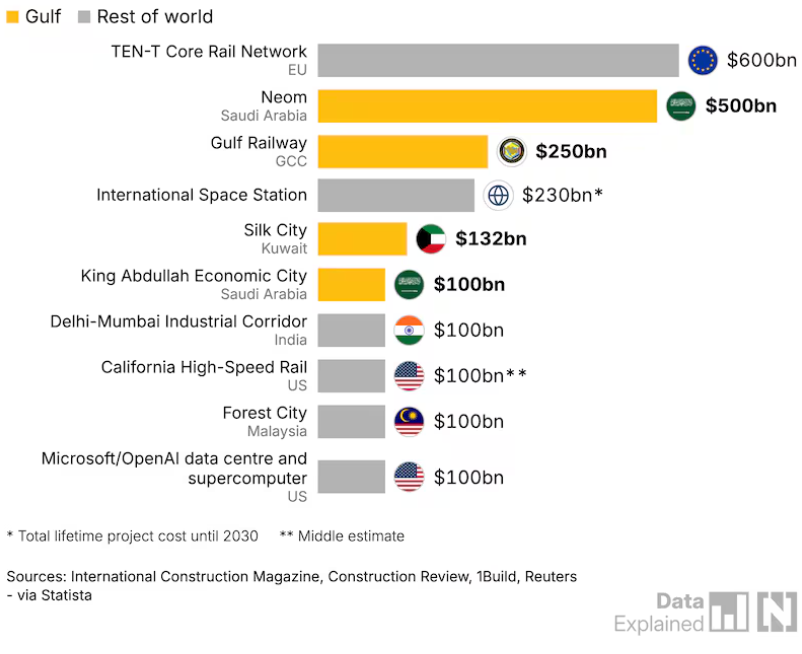
According to The National’s report on the world’s largest megaprojects, four of the ten projects in a ranking of developments with estimated costs of at least $100 billion are located in the Gulf. They include Saudi Arabia’s NEOM and King Abdullah Economic City, Kuwait’s Silk City, and the planned railway connecting the six members of the Gulf Cooperation Council (GCC). These are estimated project costs, not amounts already spent or guaranteed to be invested.
Saudi Arabia and the UAE: Competition Beyond Construction
The Gulf’s megaprojects are not simply development schemes. They are also instruments of economic influence and regional positioning.
Saudi Arabia is using its Vision 2030 programme to diversify its economy and strengthen its position as a leading Arab economic power. The UAE, meanwhile, is building on its established roles in aviation, ports, finance and logistics to expand its influence across international markets.
Their relationship combines cooperation with competition. Both countries want to attract businesses, skilled workers and foreign investment, but they are also competing for many of the same opportunities. An analysis by the Institute for National Security Studies examines the growing rivalry between Riyadh and Abu Dhabi over regional leadership and economic influence.
This competition gives megaprojects a strategic significance beyond their commercial returns. However, ambitious announcements and impressive architecture cannot guarantee long-term success. Projects still need credible financing, sustained demand and a stable environment in which to operate.
War and the Test of Investor Confidence
The conflict involving Iran has made those conditions harder to assess. Regional instability can increase shipping and insurance costs, disrupt supply chains and make investors more cautious about committing capital to projects that may take years to become profitable.
Saudi Arabia’s investment figures offer one indication of the pressure. According to Fortune, foreign direct investment into the kingdom fell by 18% in the second quarter of 2026 compared with the first quarter, reaching SAR 22.3 billion, or approximately $5.95 billion.
The decline does not prove that the war alone caused the reduction. Investment flows fluctuate for multiple reasons. Nevertheless, it highlights the challenge facing Saudi Arabia as it pursues a target of attracting $100 billion in annual foreign direct investment by 2030.
The wider regional exposure is also significant. The Center for Strategic and International Studies has examined the conflict’s effects on Gulf energy infrastructure and exports. Higher energy prices may benefit some producers, but those gains can be offset by disrupted shipments, higher security costs and uncertainty across other economic sectors.
The likely challenge is not necessarily a complete withdrawal of international capital. Rather, investors may become more selective, favouring projects with clearer demand and stronger financing while scrutinising developments that depend on optimistic forecasts or prolonged public support.
The Gulf Railway and Two Strategic Straits
The planned GCC railway is intended to connect the six member states through approximately 2,117 kilometres of rail infrastructure, with full operation targeted for December 2030, according to the GCC Railways Authority.
The network could strengthen regional trade, improve freight movement and reduce some dependence on road transport. But its broader international ambitions face a geographical limitation: the Gulf remains closely connected to maritime routes vulnerable to disruption.
The Strait of Hormuz provides a critical passage between the Persian Gulf and the Gulf of Oman. Bab al-Mandab connects the Red Sea with the Gulf of Aden and the wider Indian Ocean. Instability around either chokepoint can disrupt trade, although the consequences differ. Hormuz directly affects maritime access to the Persian Gulf, while disruption at Bab al-Mandab can force ships using the Red Sea route between Asia and Europe to divert around southern Africa.
A regional railway cannot replace these international shipping routes. Its value would depend on effective connections with ports, industrial centres, customs systems and transport networks beyond the GCC.
This does not make the railway irrelevant. In fact, instability could increase its value for regional freight and supply-chain resilience. But its ability to become a major international transit corridor will depend on the reliability of the wider transport network, not just the completion of the railway itself.
Can the Gulf Deliver on Its Ambitions?
The future of the Gulf’s megaprojects will depend on more than their budgets and construction schedules. Saudi Arabia must sustain investor confidence while financing its economic transformation. The UAE must preserve its international connectivity and commercial appeal. Across the GCC, governments must also coordinate shared infrastructure if regional integration is to deliver its full benefits.
The Saudi–Emirati rivalry may encourage investment and innovation, but it can also create incentives to pursue projects for strategic prestige rather than clear commercial returns. Shared infrastructure, particularly the GCC railway, will require cooperation as well as national ambition.
The central question is therefore not whether the Gulf can continue to build on a grand scale. It is whether these projects can attract durable investment and deliver lasting economic value in a region where geopolitical risk remains inseparable from development strategy.