







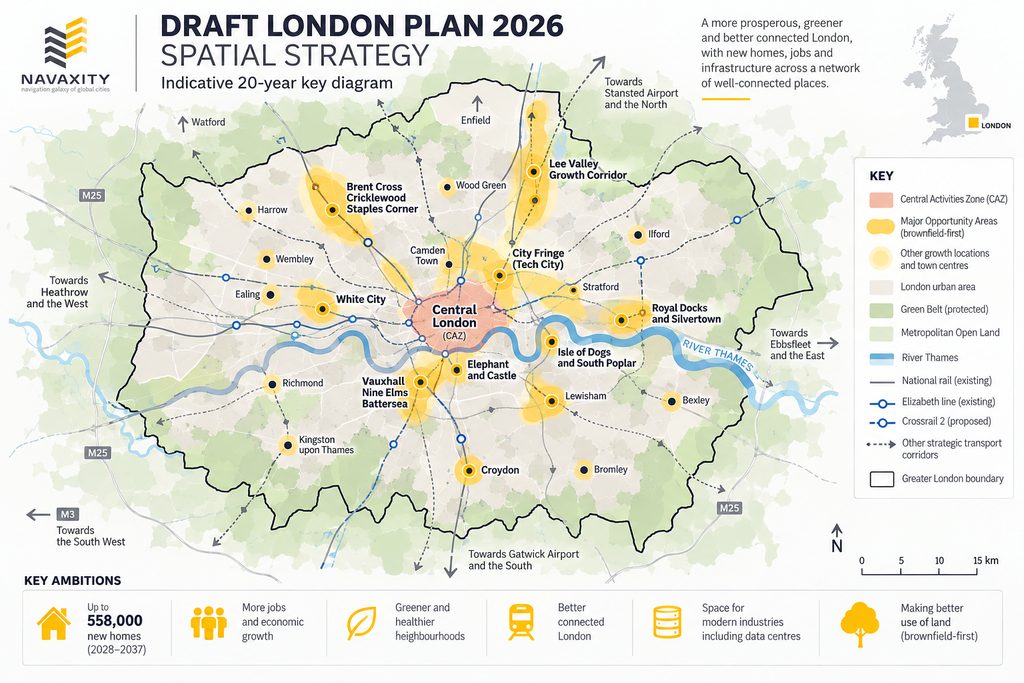
London has published a new Draft London Plan, setting out a long-term framework for housing, infrastructure, employment, transport and urban development across the capital.
Published on July 16, 2026, the plan is now undergoing public consultation until October 15, before an independent examination and expected adoption in early 2028. The document is intended to guide how London grows over the next two decades.
The new plan places particular emphasis on housing delivery, affordable homes, economic growth and digital infrastructure, including a dedicated planning policy for data centres.
London City Hall: Draft London Plan announcement
A Target of 558,000 New Homes
One of the most significant elements of the draft plan is its housing ambition.The document identifies potential for London to deliver up to 558,000 homes between 2028 and 2037, according to City Hall. The plan is intended to increase housing delivery while maintaining a focus on affordable housing and making better use of available land.
The housing target has already become a point of discussion because it is lower than the 850,000-home target set by the UK government for the same period, according to reporting by the Fitzrovia News Local Democracy Reporter. City Hall has argued that its proposed target is intended to reflect what it considers a more deliverable level of construction under current market conditions.
The distinction matters because London’s housing challenge is not simply about planning permission. Construction costs, financing, land availability and market demand all affect whether permitted homes actually get built.
Data Centres Become a Formal Part of London’s Planning Strategy
Another notable change is the introduction of a standalone policy for data centres. London is already one of Europe’s largest data-centre markets, while demand for computing capacity is increasing as cloud services and artificial intelligence expand.
The new draft plan therefore treats data centres as part of London’s future economic infrastructure alongside sectors such as AI and life sciences. City Hall says the plan will seek to ensure that sufficient land is available for these industries while also protecting land that could be used for housing and other infrastructure.The London Assembly has specifically highlighted the new data-centre policy during its scrutiny of the draft plan.
Why Data Centres Are Becoming an Urban Planning Issue
Data centres were once primarily an issue for technology and commercial real estate. Large facilities require substantial amounts of electricity, water and physical space, making their location increasingly important to city planners.
The draft London Plan proposes that planners consider factors including existing and projected electricity and water capacity, opportunities for heat recovery, proximity to existing data-centre clusters, and whether alternative uses such as housing or employment would be more appropriate for a particular site.
The policy also addresses the possibility of locating data centres on parts of London’s Grey Belt where suitable sites cannot otherwise be identified.
Data Centre Dynamics: London’s draft planning approach to data centres
Grey Belt and the Future Urban Edge
The proposed approach to data centres could have wider implications for London’s relationship with its Green Belt. The draft policy says that where suitable locations cannot be identified elsewhere, planners may consider locations within the Grey Belt or at the edge of designated growth areas.
Grey Belt refers to parts of Green Belt land that meet specific criteria under the UK’s planning framework, including previously developed or lower-quality areas. The proposal does not amount to unrestricted development across London’s Green Belt. Instead, the draft plan sets out conditions concerning factors such as infrastructure capacity, environmental impact and the suitability of alternative sites.
Housing, Industry and Digital Infrastructure
One of the central planning challenges addressed by the new London Plan is competition for land. London needs additional housing, employment space, logistics facilities, transport infrastructure and increasingly large-scale digital infrastructure. These uses can compete for the same limited areas of land.
The draft plan attempts to address this by directing different types of development toward locations where they can make better use of existing infrastructure. For example, City Hall says the plan would support modern industries such as data centres and logistics while potentially freeing industrial land in highly accessible locations for housing.
This reflects a broader change in how major cities are planning for the digital economy. AI infrastructure is no longer simply something that happens somewhere outside the city. Its requirements for power, land, cooling and connectivity increasingly affect metropolitan planning itself.
What Happens Next?
The Draft London Plan consultation runs until October 15, 2026.
After the consultation, the plan is expected to undergo an Examination in Public, where its policies and evidence base will be scrutinised before final adoption, currently expected in early 2028.
Until then, the proposals remain a draft rather than the final planning framework.