





The Northern Metropolis Hong Kong project is entering a new phase of development, as major infrastructure projects, new planning legislation and cross-border rail connections with Shenzhen move forward.
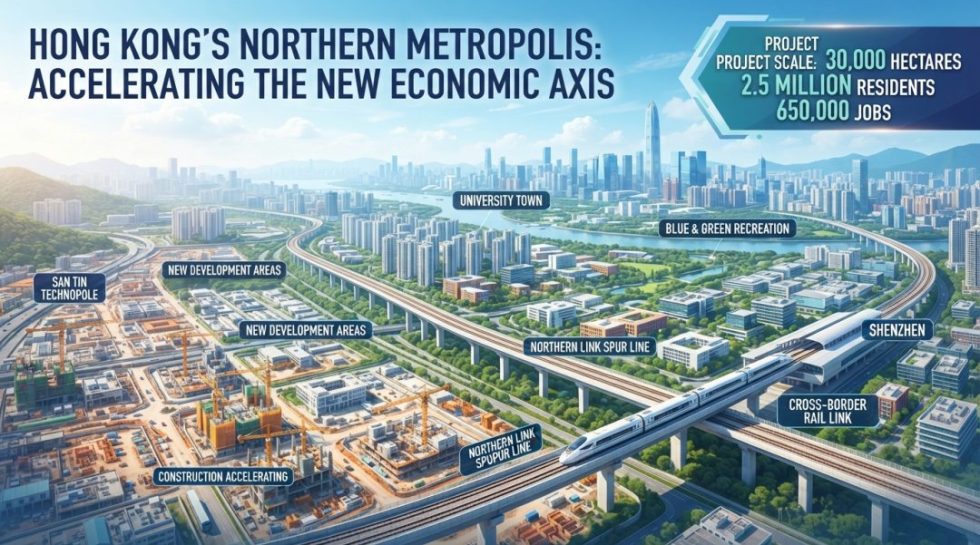
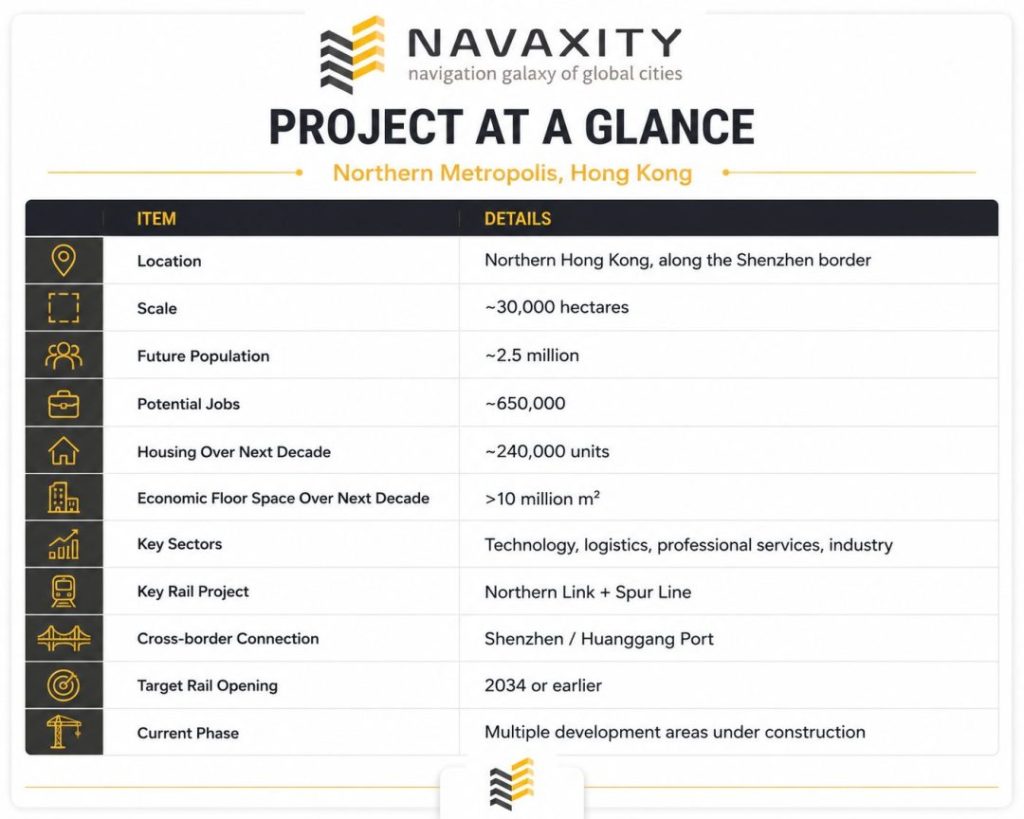
Designed to transform around 30,000 hectares of land along Hong Kong’s northern border, the Northern Metropolis is planned as a new urban and economic district capable of accommodating approximately 2.5 million residents and 650,000 jobs (Northern Metropolitan). The scale makes Northern Metropolis one of the largest urban development programmes currently underway in Hong Kong.
Northern Metropolis: Hong Kong’s Next Urban Growth Hub
According to Hong Kong’s Civil Engineering and Development Department, four major New Development Areas are already under construction, including Kwu Tung North/Fanling North, Hung Shui Kiu/Ha Tsuen, Yuen Long South and San Tin Technopole, which includes the Hong Kong-Shenzhen Innovation and Technology Park. Planning studies are also continuing for additional areas in the northern New Territories (CEDD).
The government said in July that more than 520 hectares of land had already been resumed, while around 120 hectares had been formed.
Over the next five years, Northern Metropolis is expected to deliver more than 70,000 housing units and around 1 million square metres of economic floor space. Looking further ahead, approximately 240,000 housing units and more than 10 million square metres of economic floor space are expected over the next decade (News.gov.hk).
The development is being organised around four major economic and urban functions:
- High-end professional services and logistics
- Innovation and technology
- Boundary commerce and industry
- Blue and green recreation, tourism and conservation
This structure is intended to make Northern Metropolis more than a residential expansion. The government’s objective is to build a new economic centre where housing, employment, research, industry and transportation develop together.
A New Legal Framework for the Project
One of the most significant developments came in July, when the Hong Kong government published the Northern Metropolis Development Bill.
The proposed legislation is designed to simplify planning and land procedures, accelerate construction and make it easier to establish and operate industries within the development area. The government is seeking to have the legislation passed within 2026.
The bill covers six broad policy areas and would provide a legal framework for measures including:
- simplifying urban planning procedures;
- speeding up land resumption compensation;
- facilitating construction innovation;
- streamlining certain construction-related approvals;
- managing cross-border movement of people, goods and other factors; and
- establishing statutory bodies for designated areas.
The significance is practical rather than symbolic. Large-scale urban projects often lose years not because the engineering is impossible, but because land, planning, approvals and infrastructure have to move through separate systems. Hong Kong is now attempting to reduce that friction specifically for Northern Metropolis.
Read More . . .
Hong Kong Accelerates Smart City Development Through AI and Digital Technologies
Rail Infrastructure Becomes the Backbone
Transportation is perhaps the most important piece of the project. In June, Hong Kong published plans for the Northern Link Spur Line, a cross-border railway intended to connect the Northern Metropolis with Shenzhen.
The proposed line will include approximately 5 kilometres in Hong Kong and 1 kilometre in Shenzhen, with new stations at Chau Tau, The Loop and Huanggang Port. The government is targeting commissioning of the Spur Line together with the Northern Link Main Line by 2034 or earlier.
The connection could significantly change the geography of the northern New Territories. Travel between San Tin and the new Huanggang Port is expected to take around 11 minutes once the line is operational. The Northern Link Main Line will also connect the Tuen Ma Line with the East Rail Line, strengthening the internal railway network serving the new metropolitan area.
For Northern Metropolis, the railway is therefore not simply a transport project. It is a mechanism for making the new urban district function as part of a much larger Hong Kong-Shenzhen economic corridor.
Technology at the Centre
The economic strategy behind Northern Metropolis is increasingly focused on innovation and technology. The Hong Kong Park of the Hetao Shenzhen-Hong Kong Science and Technology Innovation Cooperation Zone has already begun attracting companies. Hong Kong officials said in July that more than 90 innovation and technology enterprises had established a presence in the park.
Five additional buildings are expected to be completed during 2026, while the remaining land will be offered for tender. The government is also expanding its concept of the planned University Town. What originally involved around 100 hectares of university campus space is now being considered as a much larger 1,000-hectare-plus university town district, combining education, technology, talent, industry and urban development.
That could give Northern Metropolis a very different economic profile from traditional satellite towns, which are often built primarily around housing and commuter infrastructure.
Financing the Next Phase
The scale of the project creates another challenge: financing.
Hong Kong raised HK$27.6 billion (US$3.5 billion) in green and infrastructure bonds in May 2026, with proceeds supporting Northern Metropolis and other low-carbon infrastructure projects. The offering attracted orders of approximately HK$239 billion, around 8.6 times the amount offered.
At the same time, the government has been looking for greater private-sector participation.
A financial advisory task force involving major banks was established to explore financing solutions tailored to Northern Metropolis projects. The aim is to develop funding structures that can support the enormous capital requirements while reducing the pressure on public finances (Hong Kong Monetary Authority).
This will be one of the project’s most important tests. Building roads, railways and public facilities is one challenge. Creating enough commercial value to attract long-term private investment is another.
What Northern Metropolis Could Mean for Hong Kong
Northern Metropolis represents a fundamental shift in Hong Kong’s urban geography. For decades, the city’s economic centre has been concentrated around Victoria Harbour, Kowloon and the southern urban areas. Northern Metropolis introduces a new growth axis directly connected to Shenzhen and the wider Guangdong-Hong Kong-Macao Greater Bay Area.
The project’s success will therefore depend on more than the number of buildings completed. Its real test will be whether transportation, housing, universities, technology companies, industrial land and public services develop quickly enough to create a functioning metropolitan economy.
If that happens, Northern Metropolis could become a new economic engine for Hong Kong rather than simply another large-scale housing development. The next milestone will be the implementation of the new development legislation and the continued rollout of the Northern Link railway, while the government’s first five-year plan is expected to be published in September 2026. Northern Metropolis is expected to be one of its central development priorities.