





September 25, 2026 | Housing & Urban Development | Paris, France
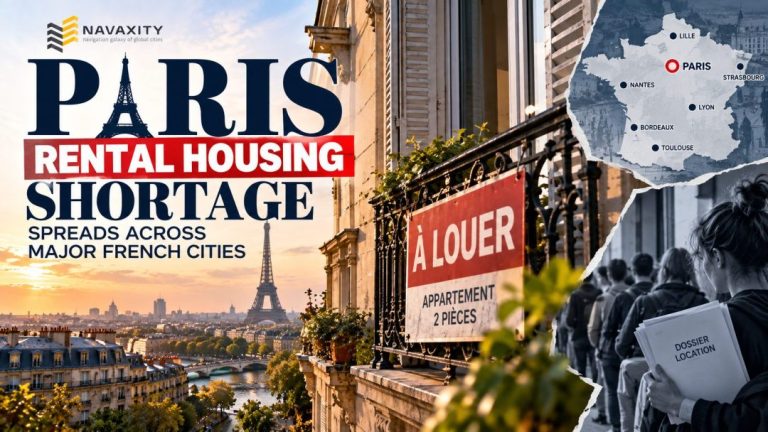
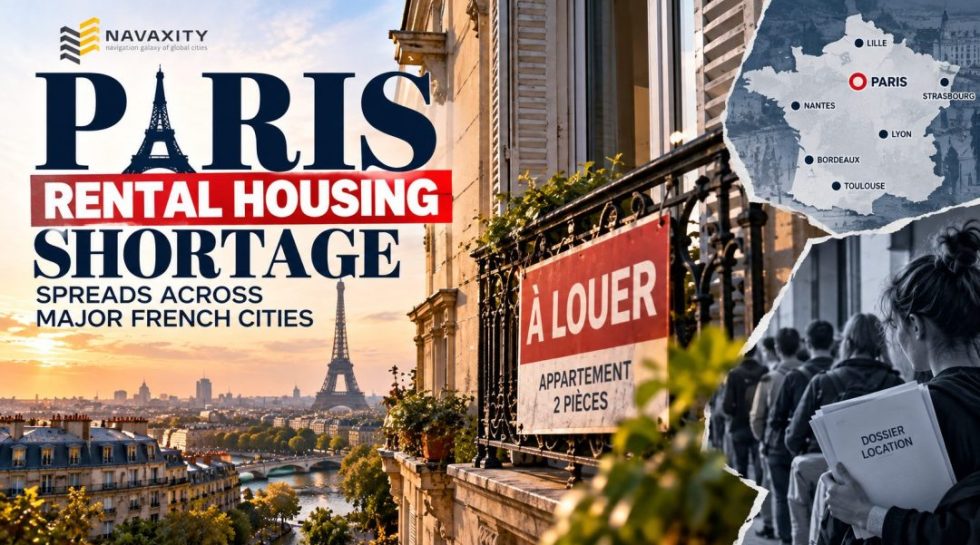
France’s major cities are facing a growing shortage of rental housing, with Paris at the center of a supply crunch that is increasingly affecting middle-income households as well as students and lower-income renters.
Rental listings have fallen sharply in recent years, while higher borrowing costs, energy-efficiency regulations and changes to investment incentives have reduced the supply of homes available for long-term rent. The pressure is particularly visible in Paris, where prospective tenants can face intense competition for even relatively modest apartments. (Le Monde.fr)
According to Le Monde, rental availability in Paris is estimated to be 30% to 40% below pre-Covid levels, based on data from property platforms and rental-management companies. Some listings have attracted more than 1,700 or even 2,000 inquiries. (Le Monde.fr)
Read the full Le Monde report on France’s rental housing shortage
Why Is Rental Supply Falling?
Several factors are contributing to the shortage.
One of the most important is the rise in interest rates since 2022. Higher borrowing costs have made home purchases more difficult for many households, keeping them in the rental market for longer and reducing turnover.
At the same time, some landlords have withdrawn properties from the rental market because of France’s energy-efficiency requirements. Properties with the lowest energy-performance ratings have increasingly faced restrictions on rental use, while owners have had to choose between renovation, sale or withdrawal from the long-term rental market.
The end of the Pinel tax incentive, which previously encouraged certain forms of investment in new rental housing, has also been identified by real-estate professionals as a factor reducing investment in rental properties.
Together, these factors have created a situation in which fewer homes are entering the long-term rental market while demand remains high.
Paris Has Particularly Tight Rental Supply
The situation is especially pronounced in the French capital.
According to Le Monde, SeLoger estimates that the number of rental properties available in Paris is currently 30% to 40% lower than before the Covid-19 pandemic.
Individual listings can attract hundreds or thousands of applications. One 30-square-metre apartment advertised at €997 per month reportedly received 1,717 inquiries, while a 20-square-metre apartment listed at €984 received more than 2,100 contacts.
The shortage is also reflected in the amount of income that households must devote to housing.
A 2026 analysis by INSEE, France’s national statistics office, found that in Paris, half of private-sector tenants spend more than 34% of their income on rent, excluding housing assistance. For single-person households and single-parent families, the median housing-cost burden is around 40%. (Insee)
Read the INSEE analysis of housing costs in Paris
Furnished Rentals Add Another Layer of Pressure
The composition of the rental market is also changing.
Some landlords are increasingly choosing furnished rentals instead of conventional unfurnished leases. Tax treatment and greater flexibility can make furnished properties more attractive to owners, while the shorter lease structure can provide greater flexibility.
The result is a reduction in the number of conventional long-term unfurnished properties available to families.
The issue is particularly relevant in Paris, where smaller apartments make up a large share of the private rental stock. Le Monde reports that some real-estate professionals are seeing a strong shift toward furnished properties.
Rental Pressure Is Not Limited to Paris
The shortage is increasingly visible across other major French metropolitan areas.
Cities such as Lyon, Strasbourg, Bordeaux, Toulouse and Nantes are also experiencing strong competition for rental properties, although the scale and causes vary from city to city.
The pressure is particularly noticeable in university cities. A September 2026 report from Le Monde found that students are competing with other groups for a limited supply of rental properties, with the shortage extending beyond the Paris region to other major metropolitan areas.
This is significant for urban economies because housing availability increasingly affects where students, workers and young families can live relative to universities, employment centers and transport networks.
Social Housing Demand Is Rising
As private rental supply becomes harder to access, more households are turning toward France’s social housing system.
At the end of 2025, approximately 2.9 million households were waiting for social housing nationwide, according to figures cited by Le Monde. Only around one in seven applications was satisfied.
In the Île-de-France region, demand through Action Logement increased by 5% in 2025 compared with 2024, and was up approximately 20% compared with 2022.
This creates an additional challenge for cities: when households cannot secure accommodation in the private market, pressure moves toward an already constrained social-housing system.
A Growing Urban Planning Challenge
The rental shortage is becoming more than a housing-market problem. It is increasingly an issue of urban structure and economic competitiveness.
When workers cannot find housing near employment centers, they may move farther from central areas, increasing commuting distances and pressure on transport networks.
For cities such as Paris, this creates a difficult balancing act between:
- increasing housing supply;
- preserving existing affordable housing;
- renovating energy-inefficient buildings;
- managing rents;
- supporting new residential construction;
- and maintaining access to employment and public transport.
The situation also highlights the importance of housing turnover. Even when the total number of homes remains relatively stable, a reduction in the number of properties entering the rental market can dramatically increase competition.
What Could Change the Situation?
Increasing supply will likely depend on several factors, including new residential construction, renovation of existing buildings, financing conditions and the regulatory environment.
INSEE data also show how significant housing costs have become for Parisian households. In 2022, a large share of private renters were already devoting more than one-third of their resources to housing, demonstrating that affordability pressures predate the latest deterioration in rental availability.
For Paris and other major French cities, the challenge is therefore not simply to build more homes. The composition, location, affordability and energy performance of those homes will determine how much they actually relieve pressure on the rental market.