







A new analysis of European climate plans suggests that cities may rely on carbon removal to compensate for a significant share of their remaining emissions, raising questions about how much decarbonisation can actually be achieved at the urban level.
European cities are increasingly looking beyond conventional emissions cuts as they pursue ambitious climate-neutrality targets. A new analysis of the climate plans of 103 European cities suggests that carbon removal could become an important part of how municipalities attempt to close the gap between their emissions and their net-zero ambitions.
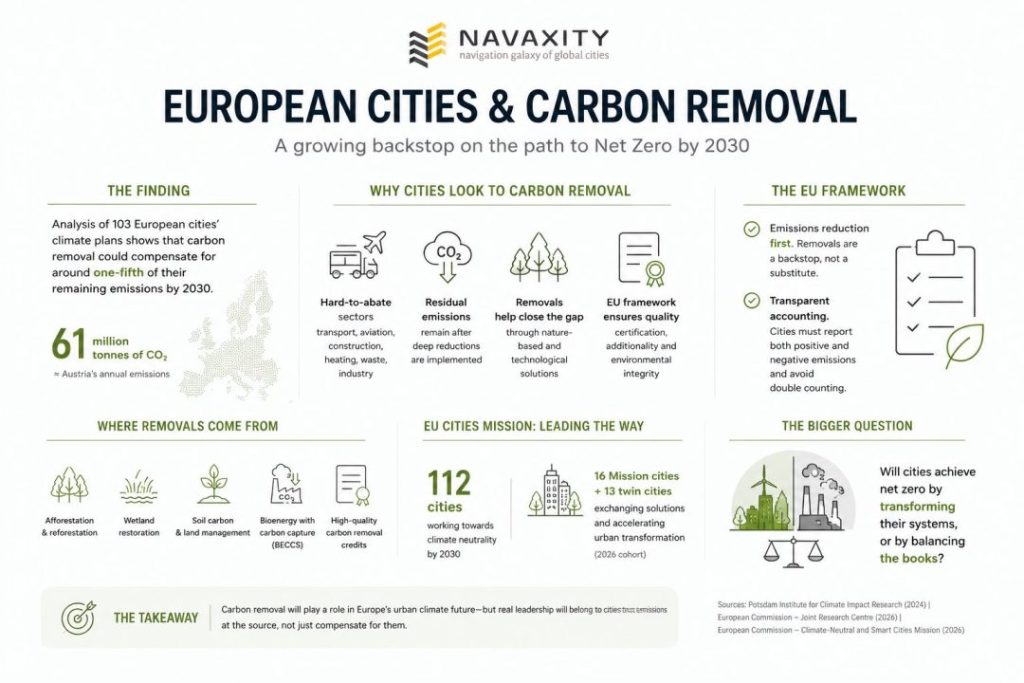
The analysis, published by the Potsdam Institute for Climate Impact Research, estimates that European cities’ current 2030 climate plans could rely on carbon removal to compensate for roughly one-fifth of their remaining emissions. The volume involved is estimated at around 61 million tonnes of CO₂, roughly comparable to Austria’s annual emissions (Potsdam Institute for Climate Impact Research).
The finding is significant because it exposes a difficult reality behind the language of urban climate neutrality: cutting emissions and removing emissions are not the same thing.
The urban net-zero problem
Cities have become central to Europe’s climate strategy because many of the decisions that determine emissions are made locally. Urban authorities influence transport networks, building standards, heating systems, land use, waste management and infrastructure investment.
The European Commission’s Joint Research Centre has recently acknowledged this challenge. Its 2026 guidance for cities distinguishes between emissions that can be eliminated and residual emissions that may need to be compensated through carbon removals or high-quality carbon credits. The Commission explicitly states that emissions reduction must remain the priority (Joint Research Centre – European Commission).
That distinction matters; A city that replaces combustion vehicles with public transport, improves building efficiency and switches heating systems to cleaner energy is structurally reducing its emissions. A city that continues producing emissions but compensates for them through forests, wetlands, bioenergy with carbon capture or other removal technologies is following a different pathway. Both can contribute to a net-zero balance, but they represent very different forms of transformation.
Why cities are looking at carbon removal
Urban economies are difficult to decarbonise completely; Heavy transport, aviation, construction, heating, waste and industrial activity can produce emissions that are technically or economically difficult to eliminate in the short term.
This is where carbon removal enters the picture; The European Commission’s framework allows cities to consider removals within their boundaries, including afforestation, revegetation, wetland restoration and certain technological approaches. Cities may also use external carbon-removal credits, provided they meet strict environmental-integrity requirements (Joint Research Centre – European Commission).
The EU is simultaneously developing a broader market framework for carbon removal. In February 2026, the European Commission adopted the first certification methodologies under its Carbon Removals and Carbon Farming Regulation, creating a common framework for certifying permanent carbon removals.
This means carbon removal is gradually moving from a niche climate concept toward a more formal part of European climate policy.
The bigger question: what happens to the city itself?
This is where the issue becomes more interesting for urban policy. If carbon removal becomes too convenient, cities could theoretically use it to compensate for emissions that would otherwise require difficult infrastructure changes. That could weaken incentives to redesign transport systems, retrofit buildings or transform urban energy networks.
The EU’s own guidance attempts to prevent this problem. Its framework places “emissions reduction first” and calls for transparent accounting of both positive and negative emissions. It also warns against double counting, requiring cities to distinguish between removals they use for their own climate balance and credits sold to external actors (Joint Research Centre – European Commission).
In other words, carbon removal is increasingly being treated as a backstop, rather than a substitute for urban decarbonisation.
Europe is already moving beyond the pilot stage
The development comes as the EU’s Climate-Neutral and Smart Cities Mission expands. The programme now supports 112 cities working toward climate neutrality by 2030, with these cities intended to function as experimentation and innovation hubs for the rest of Europe.
In July 2026, the European Commission also launched another cohort of city-to-city partnerships involving 16 Mission cities and 13 twin cities. The programme is designed to help cities exchange practical solutions and accelerate climate-neutral urban development (Research and innovation – European Commission).
The scale of the programme suggests that Europe’s climate strategy is increasingly becoming an urban transformation project rather than simply a national emissions policy.
What comes next?
The real test will not be whether European cities can achieve a mathematical net-zero balance.
It will be whether they can achieve it without becoming dependent on large-scale compensation.
That distinction could shape the next generation of European urban infrastructure.
Cities that reduce emissions at source will need major investments in public transport, clean heating, energy-efficient buildings, renewable energy, circular construction and climate-resilient infrastructure.
Carbon removal can help deal with emissions that remain after those measures. But if it becomes a substitute for them, the definition of a “climate-neutral city” risks becoming much less meaningful.
For Europe’s cities, the next decade may therefore produce two very different versions of net zero: cities that fundamentally transformed how they operate, and cities that became very good at balancing the books.
The difference between the two could matter more than the headline net-zero number itself.