The ranking is based on Oxford Economics’ 2026 Global Cities Index, which assesses 1,000 cities worldwide. Its quality-of-life category considers income equality, income per person, housing expenditure, life expectancy, crime, and access to recreation and cultural sites.
Germany has five cities in the top 21: Dresden, Berlin, Munich, Stuttgart and Freiburg im Breisgau. Bern, Basel and Zurich also place Switzerland prominently in the ranking.
The results show that economic power alone does not determine urban livability. Housing costs, public amenities and broader living conditions also influence how cities perform.
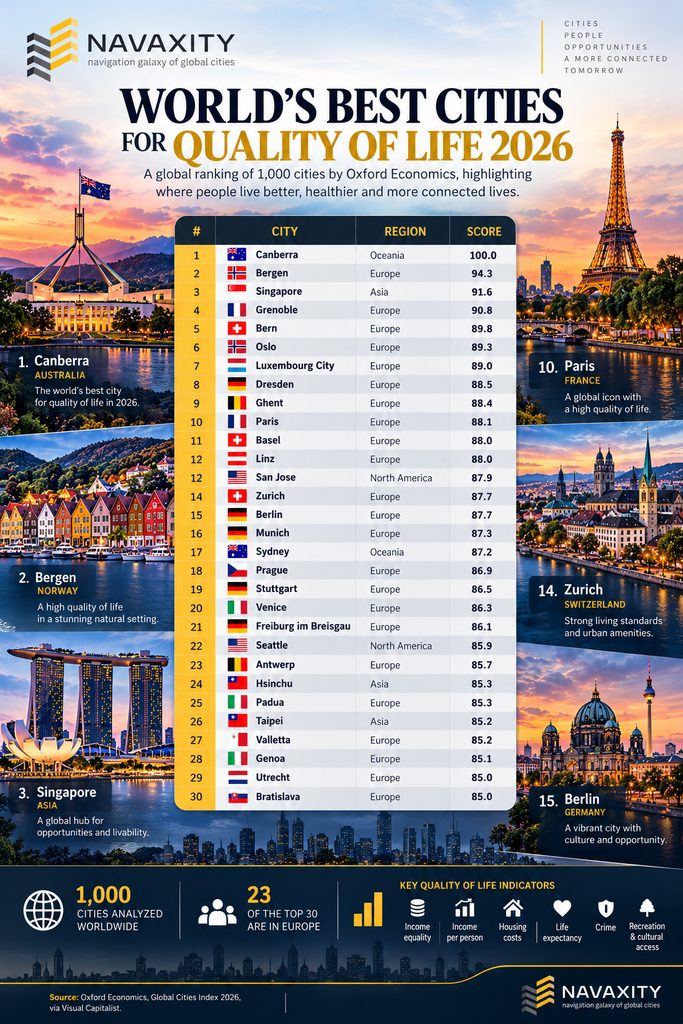
Source: Visual Capitalist, based on Oxford Economics’ 2026 Global Cities Index.
One major question raised by the ranking is the absence of Chinese and Japanese cities from the top 30. Both countries are known for their advanced railway systems, particularly China’s extensive high-speed rail network and Japan’s long-established bullet train technology. Beyond transport, major cities in both countries have adopted a wide range of urban innovations, from smart-city technologies and digital infrastructure to advanced approaches to mobility and urban services.
Their absence does not, by itself, prove that the ranking is biased. However, it does raise questions about how the Quality of Life score is constructed, which indicators carry the greatest weight, and how effectively the methodology captures the different strengths of cities around the world.
If the report is not to be regarded as biased, its results can at least be described as surprising and arguably unfair in the eyes of readers who associate China and Japan with advanced urban infrastructure and technological innovation. A closer look at the methodology is therefore essential before drawing firm conclusions about what the ranking says, and what it may leave out, about urban quality of life.