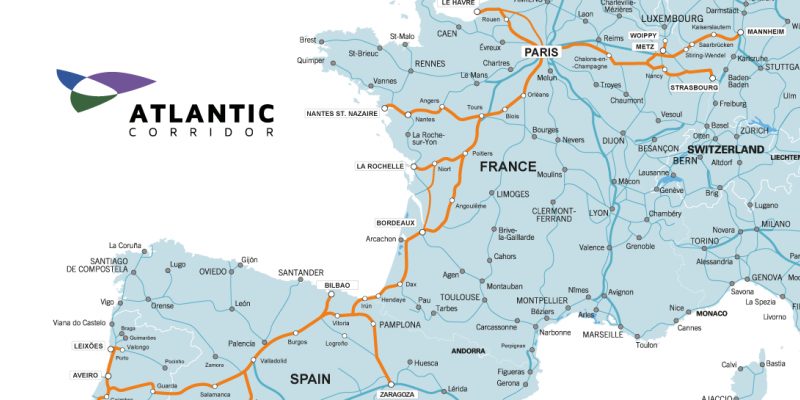
Atlantic Corridor OverviewThe Atlantic Core Network Corridor (ATL) spans approximately 11,295 km (including the CEF 2 extension), traversing Spain, Portugal, France, and Germany, with additional multimodal connections to Irish ports and airports. It links key cities—Lisbon, Madrid, Paris, Strasbourg, Mannheim—and major Atlantic coast ports like Le Havre and Brest.
More about The Atlantic corridor
ERTMS Deployment Status
Around 11% of the corridor currently uses ETCS, and approximately 39% is equipped with GSM‑R.
By March 2023, 60% of ETCS installations scheduled under the European Deployment Plan (EDP) were operational.
Under the TEN‑T Regulation, nearly 11,104 km are expected to be ETCS-enabled by 2030.
Deployment by Country
Portugal
No ETCS sections were targeted for 2023 deployment.
Completion is expected by 2030, including the CEF‑2 extension Grândola–Ermidas Sado–Sines line; however, full commissioning may extend beyond 2030.
Spain
As of 2018, ETCS covered 1,027 km (12%) of the corridor, with 7,188 km pending installation.
Deployment to reach 21% by 2023, with certain segments (e.g., Burgos–Vitoria and Córdoba–Madrid) delayed beyond that target.
France
ETCS deployment is most advanced, with approximately 714 km (83%) installed by 2023.
However, some cross-border sections—with Spain (San Sebastián–Bordeaux), Germany (Rémilly–Forbach/Saarbrücken), and domestic branches—are scheduled post-2023.
Germany
Only 136 km remained to be commissioned by 2025, with ongoing works between the German–French border and Mannheim.
Timeline & Future Priorities
Year
Objective
2023
Achieve envisaged ETCS coverage per EDP—progress varies by country
2030
Full ETCS rollout (~11,104 km) in line with TEN‑T standards
Aligning national plans (NIPs) with the European EDP
Completing cross-border ETCS and GSM‑R corridors
Resolving gauge mismatch in the Iberian region
Enhancing multimodal integration at ports, inland waterway nodes, and airports
Summary
The Atlantic Corridor is well underway in its ERTMS roll-out, achieving solid progress in France and Germany, while Spain is advancing albeit with delays, and Portugal will ramp up after 2023. Full functionality—including ETCS and GSM‑R—by 2030 remains the overarching goal, supporting seamless, interoperable, and greener rail operations across Europe.